
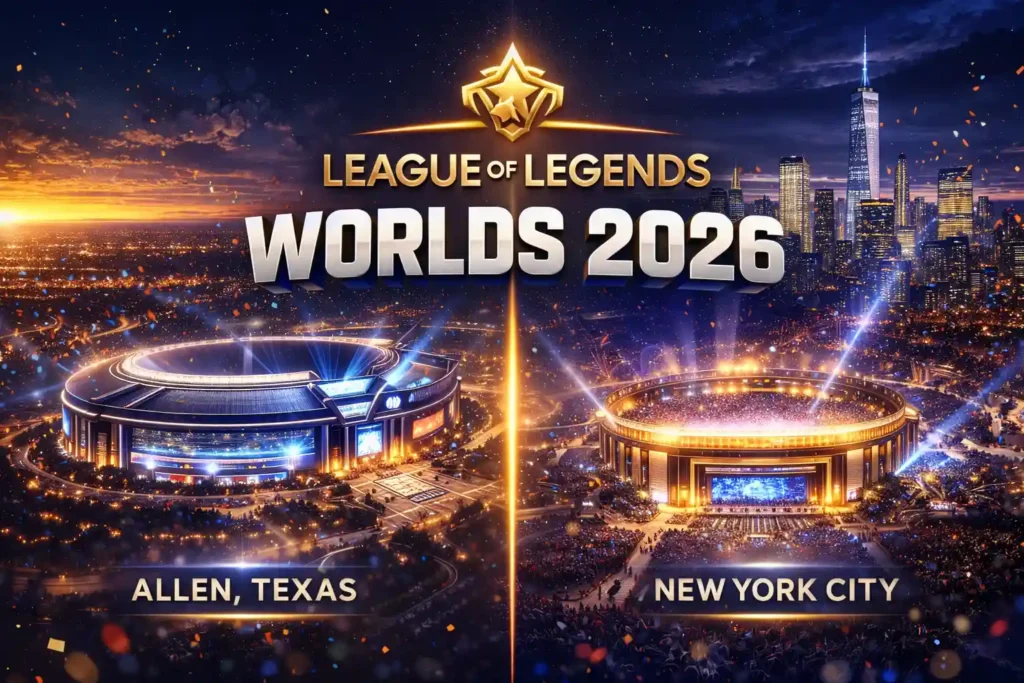
The League of Legends World Championship has always been the biggest event in competitive League of Legends. Every year, it brings together the best teams from around the world, millions of viewers, and storylines that define entire seasons. But Worlds 2026 is shaping up to be more than just another edition—it represents a clear evolution in how Riot Games wants global esports to function.
With major format refinements, a new multi-city hosting strategy, and growing pressure from global mega-events like the Esports World Cup, Worlds 2026 is positioned at a critical crossroads for the League of Legends ecosystem.
Here’s everything we know so far about Worlds 2026, why it matters, and how it could shape the future of competitive League of Legends.
What Is League of Legends Worlds?
The League of Legends World Championship, commonly called Worlds, is the pinnacle tournament of the League of Legends competitive calendar. Organized by Riot Games, it crowns the best team in the world after months of regional leagues, international qualifiers, and playoffs.
Worlds is more than a tournament—it’s a cultural moment for the game. Skins, cinematic videos, music releases, and global watch parties all revolve around it.
By 2026, Worlds will have run for over 15 years, and Riot is clearly not interested in letting it stagnate.
Where Will Worlds 2026 Be Held?
Worlds 2026 will take place across multiple cities in the United States, continuing Riot’s trend of hosting the event across several venues rather than a single location.
Confirmed Hosting Regions (So Far)
- Texas – expected to host early stages
- New York City – likely venue for semifinals or finals
This multi-city approach allows Riot to:
- Reach more fans in different regions
- Use larger, purpose-built arenas
- Create stronger local esports activations
It also mirrors traditional sports championships, where events scale up as the tournament progresses.
Why Riot Is Using a Multi-City “Hub” Model
Running Worlds in a single city for a month is expensive and limiting. Riot’s newer approach is closer to a hub-based tournament model, where teams stay in one country but move between a few major cities.
This strategy offers:
- Better logistics for teams and production
- Higher-quality broadcasts
- Stronger partnerships with local sponsors
It’s also a response to rising costs in global esports. Centralization helps Riot maintain quality without inflating budgets unnecessarily.
Worlds 2026 Format: What’s Changing?
While Riot hasn’t revealed every detail yet, several format trends are already clear.
Continued Use of Swiss-Style Stages
Recent Worlds events introduced Swiss-style formats to reduce meaningless matches and increase competitive integrity. Worlds 2026 is expected to refine this system further, ensuring:
- More matches between similarly skilled teams
- Fewer “free wins”
- Faster elimination of underperforming squads
Higher Emphasis on Competitive Consistency
Rather than rewarding teams for a single upset win, Riot appears focused on formats that reward consistent performance across multiple matches.
This aligns with Riot’s long-term goal: identifying the strongest team overall, not just the hottest team on one day.
Regional Slots and Global Balance
Worlds 2026 will once again feature teams from all major regions:
- LCK (Korea)
- LPL (China)
- LEC (Europe)
- LCS (North America)
- Emerging regions such as PCS and VCS
However, Riot continues to adjust slot allocation based on international performance. Stronger regions are rewarded with additional seeds, while weaker regions face tighter qualification paths.
This keeps Worlds competitive while still maintaining global representation.
How Worlds 2026 Competes With the Esports World Cup
One of the biggest changes in the esports landscape is the rise of large, multi-title events like the Esports World Cup.
Unlike Worlds:
- Worlds is single-game focused
- Riot retains full control over the ecosystem
- Competitive integrity is prioritized over spectacle
Rather than replacing Worlds, events like EWC increase pressure on Riot to:
- Keep prize pools attractive
- Maintain production quality
- Ensure Worlds remains the ultimate LoL achievement
So far, Riot has shown no signs of backing down.
Production, Broadcast, and Viewer Experience
Riot has consistently raised the bar for Worlds production, and 2026 is expected to continue that trend.
Fans can expect:
- Enhanced AR and stage visuals
- Cleaner broadcast overlays
- More behind-the-scenes content
- Improved co-streaming support
Worlds isn’t just watched—it’s experienced. Riot understands that presentation matters as much as gameplay.
Why Worlds 2026 Matters More Than Ever
Worlds 2026 comes at a time when esports is maturing. Investors are cautious, teams want sustainability, and fans want authenticity.
Worlds represents:
- Stability in a volatile esports market
- A gold standard for competitive integrity
- Proof that publisher-run ecosystems can still succeed
For professional players, winning Worlds remains the ultimate career achievement. For fans, it’s still the one event that defines the year.
Final Thoughts
League of Legends Worlds 2026 isn’t reinventing the wheel—but it is refining it.
With smarter formats, better logistics, and a renewed focus on competitive fairness, Riot Games is positioning Worlds to remain esports’ most prestigious single-title championship. While global mega-events continue to rise, Worlds still holds a unique place that no other tournament has managed to replace.
If esports is entering a new era, Worlds 2026 will be one of its defining chapters.